The inner colored ring of the Scale Circle is made of arcs. Each arc is the distance from one scale note to the next. Together they spell out the scale’s formula — the one musicians learn by heart: “whole, whole, half…”.
What the arcs say
- H — a half step, two neighboring piano keys;
- W — a whole step, two half steps;
- W+H — a step and a half;
- 2W, 2W+H and wider — big leaps, found in five-note scales and in chords.
Color saves you reading the labels: whole steps are orange, half steps are pink, steps and a half are light blue. One arc may be gold: that is the scale’s characteristic interval — the step that gives the scale its recognizable sound.
The arcs are the scale’s formula
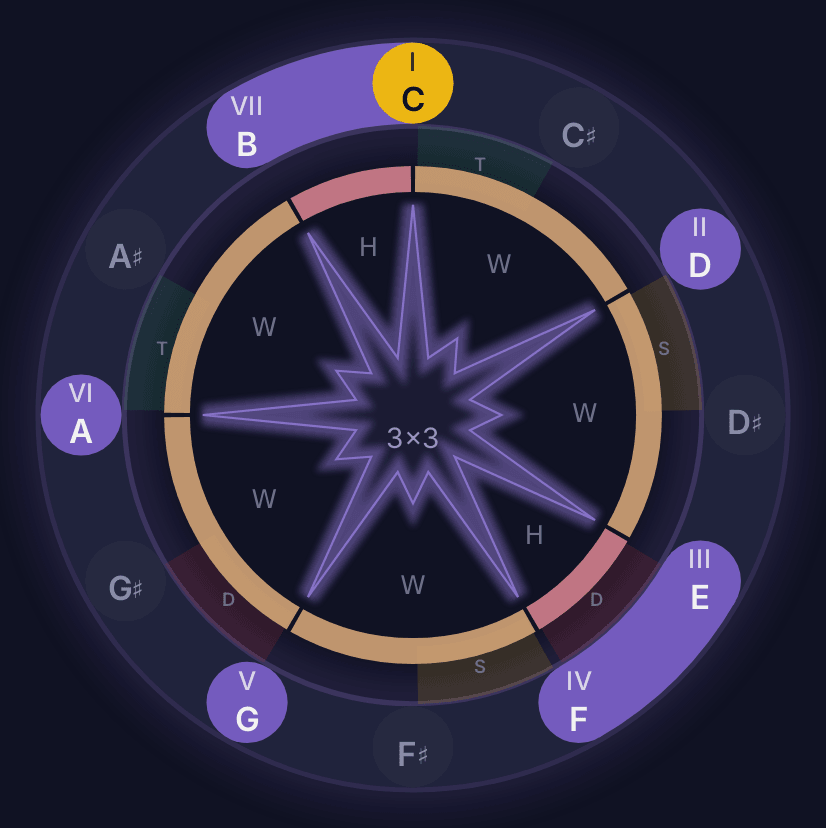
Read the arcs of C major clockwise from the tonic C: W, W, H, W, W, W, H. That is the formula of the major scale. It is the same for major from any note — which is why the star is the same too.
All the arcs together always add up to exactly one octave — 12 half steps: 2+2+1+2+2+2+1 = 12.
How the arcs show a scale’s character
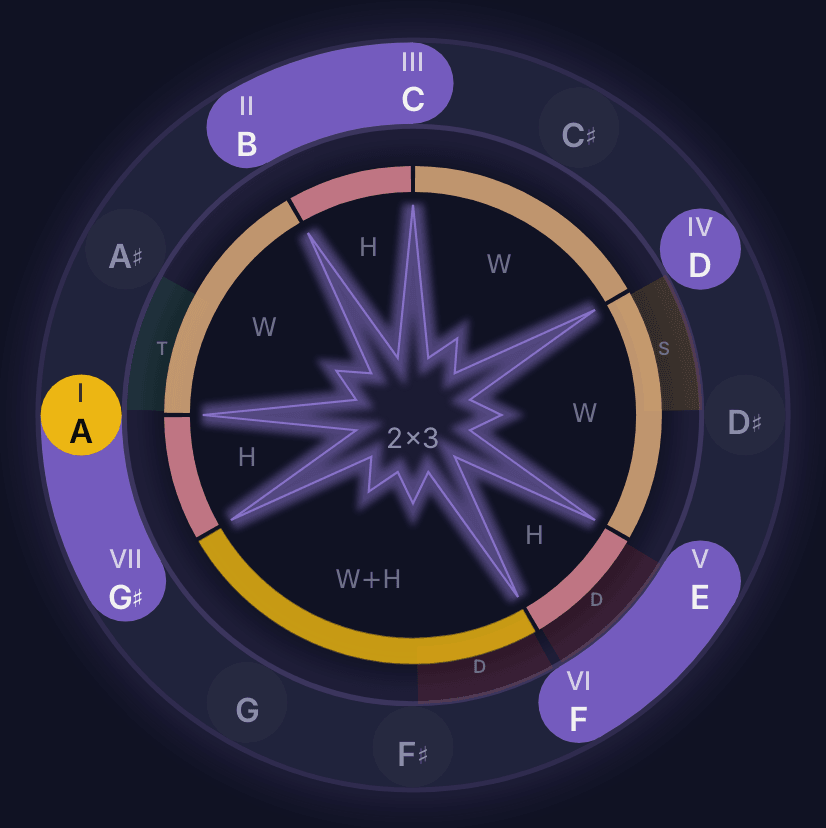
This is A harmonic minor. It differs from natural minor by one note — G♯ instead of G. The arcs show right away what changed: a W+H arc appeared between F and G♯, and it is gold: this is the characteristic interval of harmonic minor. That wide step gives it its “Eastern” flavor. At the same time the G–A arc is gone, and in its place there is a pink half step G♯–A: the leading tone pulling toward the tonic.
Wide steps

A pentatonic scale spreads five notes over twelve half steps, so its steps are wider: only W and W+H — W, W+H, W, W, W+H — and no half steps at all. The absence of pink arcs is what gives the pentatonic its soft sound with no sharp corners.
Read next
- The star on the Scale Circle: the shape of a scale
- Notes on the Scale Circle: tonic, degrees, sharps and flats
- The Scale Circle in the Studio: scale and chord, 7th degree, scale chords
Still have a question? Ask it in Questions.