The colored sectors in the outer ring of the Scale Circle, marked T, S and D, show harmonic functions — the role a chord on each degree plays in the scale. The number in the center, for example 3x3, is the family formula: how many major and minor triads the scale can lean on.
T, S, D — what they are
In harmony, the main chords of a scale have roles:
- T — tonic: home, the point of rest;
- S — subdominant: moving away from home;
- D — dominant: tension that pulls back to the tonic.
Colors: T is green, S is yellow, D is red.
How the circle finds them
The textbook rule “I is the tonic, IV the subdominant, V the dominant” only works for major and minor. The Scale Circle finds functions from the triads the scale actually contains, so they make sense for any scale:
- all the major triads on the scale’s degrees are taken in order from the tonic and labeled T, S, D;
- the same is done for the minor triads — that is the second, minor system.
The circle shows both systems at once, on the same ring.
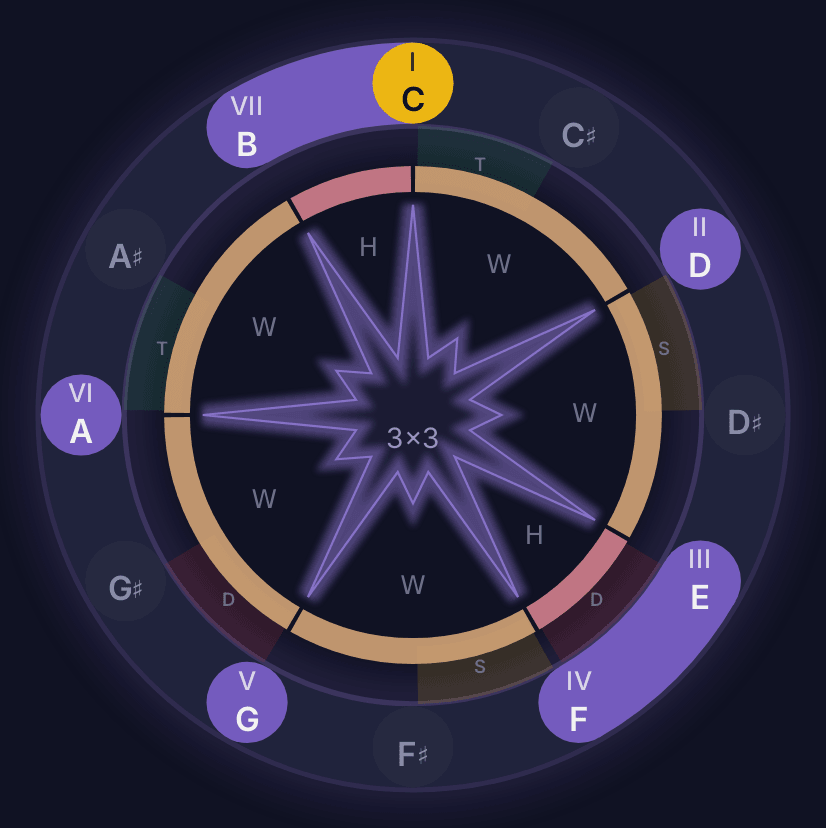
In C major the major triads are C, F and G: that is T, S, D of the major system. The minor triads are Am, Dm and Em: that is T, S, D of the minor system, centered on A minor. That is why C major shows six colored sectors, not three.
If a scale has four major triads, as the diminished scale does, a fourth function appears — P, in blue.
Choosing the center of the minor system
By default the center of the minor system is the relative minor: for C major that is A minor. But you can pick the minor center yourself: tap the colored sector of a minor degree.
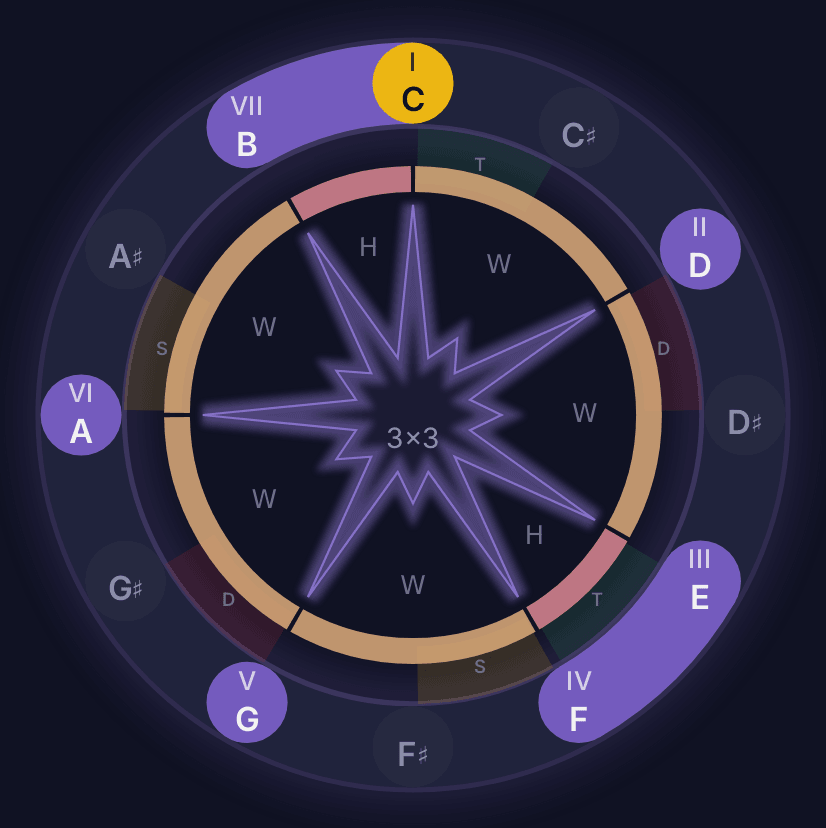
Here the sector at E was tapped. Now the minor system is counted from E minor: Em is T, Am is S, Dm is D. The scale’s notes do not change — only which minor chord counts as home.
The family formula: 3x3
The number in the center of the circle is the formula: major triads × minor triads on the scale’s degrees. One formula describes a whole family of scales, because all modes of a family are made of the same notes:
| family | formula |
|---|---|
| diatonic: major, natural minor, Dorian and the other modes | 3x3 |
| harmonic minor | 2x3 |
| harmonic major | 3x2 |
| melodic minor | 2x2 |
| double harmonic | 3x3 |
| diminished | 4x4 |
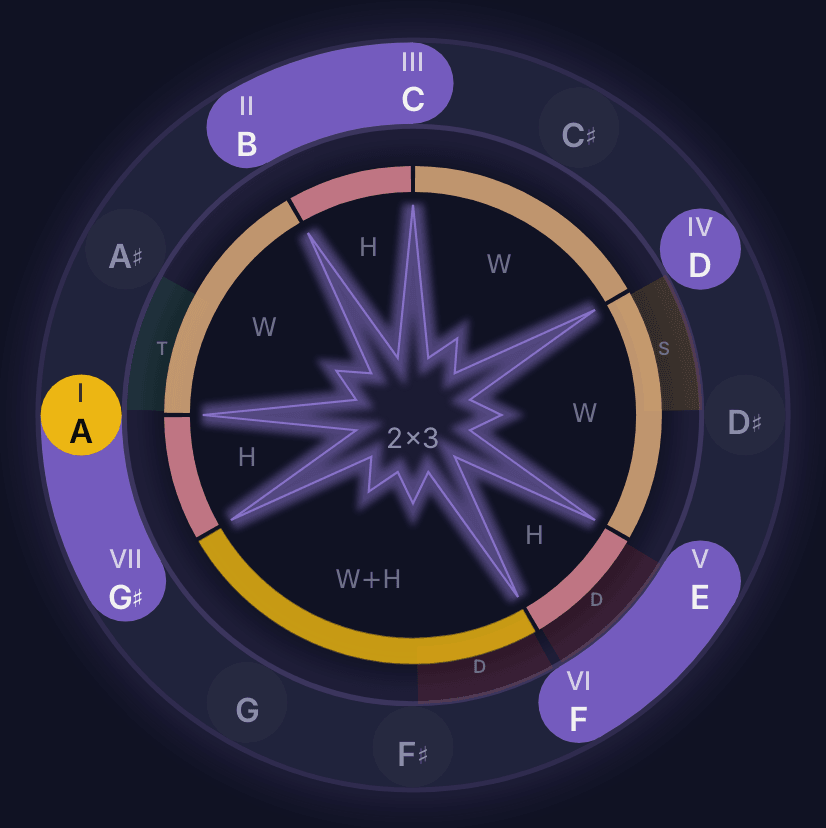
Compare: natural A minor is 3x3, harmonic A minor is 2x3. One note — G♯ instead of G — and the scale has one major triad fewer. The formula tells you at once how much “more major” or “more minor” a scale sounds.
Triads are counted by sound
The formula counts chords by how they sound, not by how they are spelled. A harmonic minor has three minor triads: Am, Dm — and F–G♯–C. On paper that is not a minor triad, but G♯ and A♭ are the same key, and it sounds exactly like F minor. So the formula is 2x3, not 2x2.
Read next
- The Scale Circle in the Studio: scale and chord, 7th degree, scale chords
- Same notes or same tonic: long press and the › ‹ buttons
- Scale Circle: what it is and how it is built
Still have a question? Ask it in Questions.